
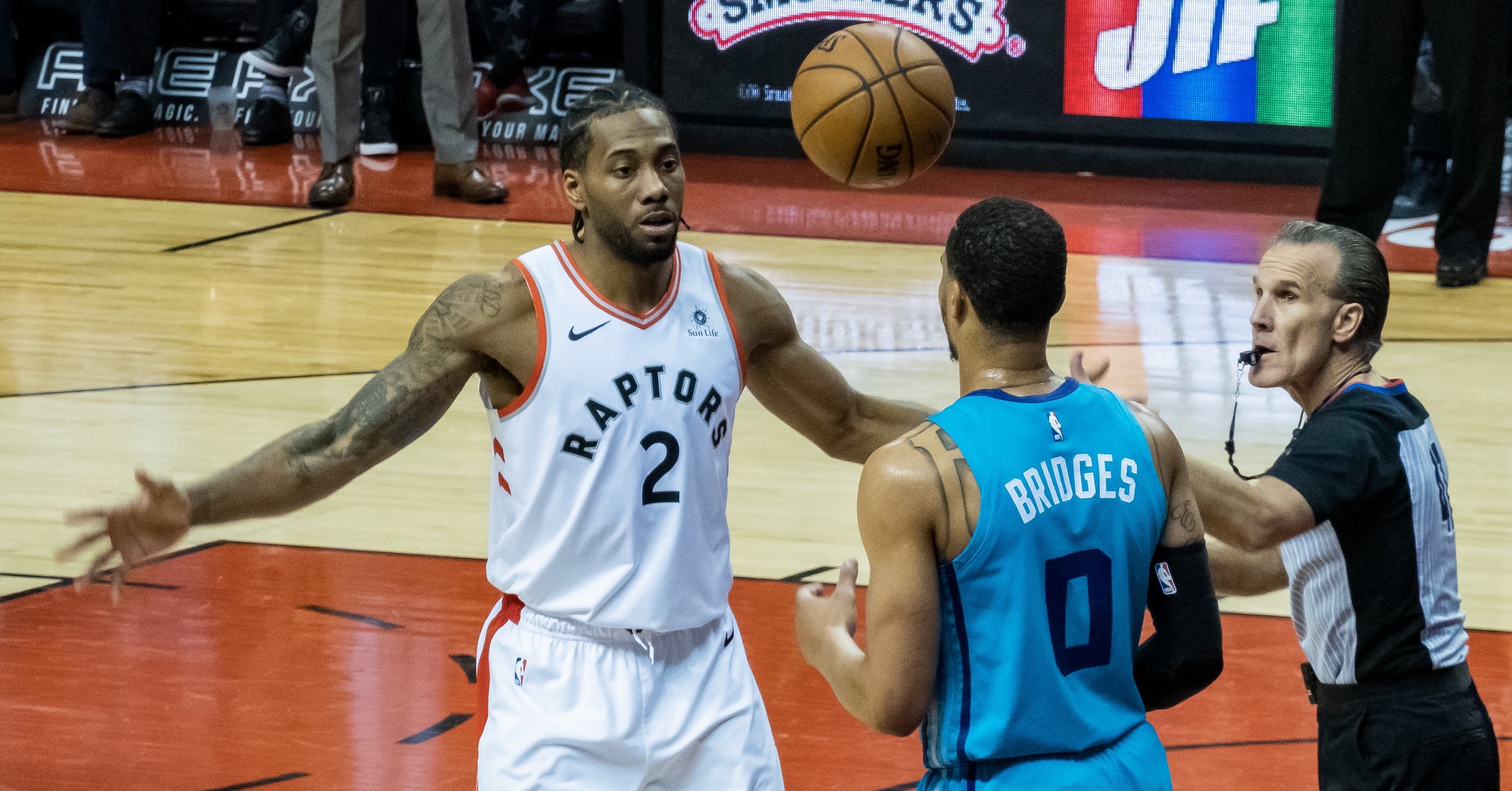
With the recent announcement of the Toronto Raptors trading for Kawhi Leonard and bringing him back to the team after a seven-season absence, I was prompted to reread one of the articles I wrote back during his first tenure with the team. I was surprised at how much I wrote back still applies to his prospective new stint with the Raptors.
***Iwas furious. Not only had Masai Ujiri fired Coach of the Year Dwane Casey in May, now he had traded away DeMar DeRozan for some guy from the San Antonio Spurs whose name I didn’t even recognise. Along with some other guy whose name I didn’t recognise either. My fury was based, in part, on a very weird, very Canadian reason. DeRozan actually liked playing in Toronto, and we liked him back for almost that reason alone. Surprisingly, that’s really important to us. Canadians have this unhealthy need to be liked. Particularly by Americans. DeRozan’s remarkable skills as a player didn’t hurt, of course, but we found it endearing that he did not appear to simply be putting in time until he headed south again. After being selected ninth overall by the Raptors in the 2009 draft, DeMar DeRozan had played his entire professional career in Toronto. He also gave every indication of wanting to play out his days with the team. The new guy—whoever he was—didn’t seem to hold the same view at all. There were even stage-whispered rumours that he wouldn’t show up for training camp when the time came.
Besides, the changes just seemed so unnecessary. The Raptors had made it through to the second round of the 2018 playoffs. Even with the four-game sweep in that series, the latter lack of success was pretty easy to set aside and not worry about too much. The Raptors had been steamrolled by none other than LeBron James, one of the greatest to ever play the game. Next year, many a Raptors’ fan thought, they would just have to figure out a way of not playing any team for which LeBron played. Stay the course seemed to be the collective wisdom. There was always next year. But fire a well-liked, highly effective coach and trade away the best player who the fans loved? Had Ujiri and General Manager Bobby Webster completely taken leave of their senses? Had they not watched the same games we had all watched and come to the same blindingly obvious conclusions?
Apparently not.
***Most would say I’m the luckiest man alive. My wife, Michelle, is a way bigger sports fan than I’ll ever be. And I like sports—a lot. She is also very knowledgeable of the games she watches. Her laptop is never far away as she digs into statistics and looks up jargony terminology used by the announcers so as not to miss any nuance of what they’re saying. As a result of her careful study of the games she watches, I would defy anyone to outwit her post-game analysis. But her very nature means that analysis has an audience of exactly one. Me. She’s my Cyrano de Bergerac—she whispers things in my ear which I then say out loud and everybody seems impressed.
So when Michelle’s insightful gaze turned to NBA basketball a couple of years ago, I was happy enough to have it on the TV as I absently worked on something else on my laptop. The NHL Calgary Flames had crashed out of the Stanley Cup playoff race at the end of the season, and there was a dearth of playoff sports on our TV. So NBA it was, and it’s easy to be a new fan when your team is winning. Oh, and for those not familiar with Canadian geography—which is just about everybody who doesn’t live here and, frankly, many who do—Scotiabank Arena, where the Raptors play, is thirty-two driving hours from Calgary. It’s a tenuous argument for a home team, but that forty-ninth parallel still counts for something. Even if Toronto is actually closer to the forty-fourth.
While it is technically grounds for treason here in Canada, I began to feel basketball was actually more entertaining than hockey. It’s just as fast—maybe faster—and the action is constant, although both sports suffer from too many whistles, video reviews, and TV time-outs. Hockey players, whose armour is necessary to prevent their death during the game, all kind of look the same. Particularly during the playoffs when they all sport a scruffy beard. Basketball players, on the other hand, are basically just out there in their beach attire for all the world to see. It makes the sport more character-driven than hockey. You feel you know them better simply by being able to see more of them. And then there’s the pre-game Walk-In, where the uniqueness of the players is fully on display. I think it’s great, although it may be for no better reason than it must drive the suit-and-tie obsessed Don Cherry absolutely nuts.
All of that, and no spitting. What’s not to love?
In the 2018 NBA playoffs, I found my heart beating a little faster when the Raptors knocked out Washington in seven games. The eternal sports optimist that I am—Michelle is a little more pragmatic—I thought the Raps were always on the verge of turning it around right up to the final buzzer in game four against the Cavaliers. They had, however, met the unstoppable King James. The only justice in that series was that the unstoppable eventually met the immovable Golden State, where the Cavs suffered their own karmic, four-game humiliation.
Despite the early exit, though, I now considered myself a basketball fan. A new fan, nonetheless, and still a pretty ignorant one despite Michelle’s best efforts to make me smarter about the game.
***“Load management,” I asked Michelle. What’s this thing Matt and Jack keep talking about called load management? She looked puzzled, shrugged, and tapped away on her laptop. For the $23-million Kawhi Leonard was being paid for his one year with the Raptors, I would have thought, short of grievous bodily injury, he could play every game. That wasn’t the case, according to Michelle. There were simply some games for which he was allowed to rest. I have to say, there were nights Kawhi Leonard seemed to be carrying the entire team on his shoulders, and I suppose that is a load which does need to be managed from time to time. Deadshot Danny Green, on the other hand, seemed to go out night after night with a beaming smile and his chatty, made-for-life-after-basketball persona and knock down three-pointers with abandon. I began to think if Green was part of the bargain for Kawhi Leonard, then Ujiri and Webster had done pretty well after all. When Kawhi’s exospheric contract renewal came up at the end of the season, inevitably sending him back south, I hoped the Raptors might still be able to make a deal to keep Green in the lineup for the following season. He was just so easy to like.
By stark, jarring comparison, Kawhi Leonard seemed to be living up to those stage whispers. Although the trade had occurred in July, the press conference in which Leonard and Green were introduced to the local media wasn’t arranged until late September, just before the season started. It was fingernails-on-a-blackboard painful to watch. Virtually all of the questions from the local press—until pointedly asked by host Ujiri to move on—were all variations on the c’mon Kawhi, please tell us you like us. Without breaking a sweat, Leonard’s barely audible, minimalist, no-eye-contact answers all referred back to his love of the game, his desire to play for a great team, and above all, being able to put his name on a couple more championship trophies and, in so doing, the record books for a long, long time. At no point did he offer anything more than cursory common courtesy for Toronto being a great city. It was like watching the cringeworthy episode of Seinfeld where hapless lothario George Constanza looks his paramour in the eye and says I love you only to have her say yeah, I know, I heard you the first time.
The first four words of Kawhi Leonard’s answer to the first question of the press conference, if you listen very carefully, were I’m a fun guy, followed by a broad smile and a quirky laugh. It’s a good thing we have YouTube to pause and rewind, because it would be just about the last time we would see that smile or laugh until the end of the season, then eight months in the future. In an irony lost on exactly no one, the audience would have been left with the polar opposite impression of Leonard. Basketball was his profession and his craft more in line with—say—Kyūdō, the ancient Japanese martial art of ritual archery, rather than the rowdy pickup games Leonard would have played when he was a kid in Southern California. At this point in his career, having fun seemed to be completely incidental to Leonard’s almost monk-like devotion to the game. At the very least, whatever fun he may someday have would be a direct result of success on the court and virtually nothing else. His commitment to the Raptors and their fans was that. Nothing more.
Meanwhile, the folks over at New Balance must have been going into cardiac arrest. Kawhi Leonard had reportedly walked away from a $22-million offer from Jordan to renew his shoe deal. He had then signed a presumably much more lucrative contract with New Balance, which, leveraging up their risky bet on Leonard, was not really known for its basketball shoes. In the world of superstar endorsements, the likability of the star doing the endorsing would seem to be pretty important. What else could have explained Michael Jordan appearing in the movie Space Jam or his grotesque appearance making cookies on the Martha Stewart show? There is no way of knowing how the conversation between New Balance and the Leonard camp proceeded from that September press conference. However, there is not much evidence to suggest any desire by the shoe company to make Leonard more likable—or even just possessing ordinary human emotions—had fallen on anything but deaf ears. However, there was a burgeoning respect for Kawhi Leonard’s undeniable, progressive success over the course of the Raptors’ season. New Balance eventually elected to go all in with the stern, taciturn, all-business identity of their star spokesman, who rarely spoke. As his stats and the resulting victories began to pile up, they put up a ten-storey poster of the unsmiling, closed-body language Leonard at the corner of Yonge and Dundas in downtown Toronto. They used exactly two words to brilliantly—or maybe just desperately?—make their point:
Fun Guy.
***Kawhi’s stock began an astonishing bull run during the 2014 NBA Finals. He was series MVP for the San Antonio Spurs as they defeated the Miami Heat in just five games. Later that year, he presented the game ball to President Obama at the White House, but, again, without uttering a single audible word in doing so. Every year subsequent to that, Leonard had accumulated a growing list of accomplishments and was steadily working his way to near universal acclaim as one of the best two-way players in the league, if not one of the best outright. Leonard’s numbers objectively backed it up.
However, something was amiss heading into the 2017/2018 season. Kawhi did not appear in the first twenty-seven games as a result of an injury to his right quadriceps sustained before the season got underway. He came back, probably under duress, for a few games in December and January but was quickly out again—this time, indefinitely according to the Spurs’ management. Kawhi went to New York for most of February to consult with his own doctors, who seemingly came to a different conclusion regarding their patient’s fitness to play.
By March, there was a barely concealed and growing rift between Kawhi and the Spurs’ organization, culminating in a players-only meeting later that month. It was said to be tense and emotional, where at least some of his teammates specifically asked him to return to play. The team doctors, they would have said, had declared him fit. Evidently, Kawhi disagreed. By pressuring him to play, they were effectively calling bullshit on his injury. That lack of trust, and that alone, would seem to have made it intolerable for Leonard to continue playing for Coach Gregg Popovich and the Spurs.
Indeed, Kawhi Leonard would not play for the Spurs again. By June, it was public knowledge he wanted to be traded, preferably to his hometown Los Angeles Lakers or Clippers. In July, there came the surprise announcement that Leonard was going to Toronto. This was the genesis of the notion the Raptors were at least his third choice, if, in fact, they were on his list at all.
***The fragile Calgary Flames had, once again, been dispatched in the first round in just five games at the hands of the Colorado Avalanche. They had crumpled like a cheap suit on a rainy day. It was mid-March when they had clinched a playoff spot, and their second place overall in the league standings made it appear they had all of what it would take to make a deep run into the Stanley Cup playoffs. Stunningly, their play in the first round looked like they had intentionally been given the wrong start times for everything but the first game. The Flames’ pathetic, precipitous collapse was thoroughly disorienting in our household and no doubt many others. Above all, the Flames had committed the almost unforgivable sin of professional sports: they simply lost their will to win.
While that slow-motion train wreck was unfolding, the Raptors had been steadily playing their way into their fans’ hearts and minds all winter long. Kyle Lowry gamely argued every single call that went against the Raptors while also field marshalling the team much of the time. Danny Green was utterly lethal from an open corner. Pascal Siakam was a freakishly different player than the year before—so much improved you would think it was a different guy. Norm Powell and Fred VanVleet contributed timely three-pointers all year long that made us cheer out loud. We wept a little when, at the deadline, the happy warrior giant Jonas Valanciunas was cold-heartedly traded away to Memphis for Marc Gasol. Former star of our beloved Oregon Ducks, Chris Boucher, never got to play as much as we would have liked, but demonstrated flashes of brilliance when he did. Coach Nick Nurse regularly contributed his drop-jawed faux incredulity at some call he didn’t like. That always made us laugh. They all seem to be having the time of their lives, and in our own small way, so were we. Not once do I recall the Raptors giving the impression there was a game they couldn’t somehow win.
Then, there was the inscrutable Kawhi Leonard.
In all my days of watching sports, I don’t think I have ever seen a player who has played so much within himself during the game. Even Wayne Gretzky, a virtual deity in Canada and known as one of the nicest guys in professional sports, would still argue what he thought was a bad call. He was even known to have dropped the gloves. Just once that resulted in five minutes for fighting, mind you, and his performance is utterly comical to watch. His opponent, Neal Broten of the North Stars, at first appears stunned. The Great One would stoop to such a thing given it was so much out of character. Broten then effortlessly drops Gretzky to the ice, of course. It’s a case study of sticking to what made you great in the first place.
Kawhi Leonard, on the other hand, over the course of his entire career has given virtually nothing away while playing. Outside the forty-eight game minutes, he is virtually invisible. The questionable calls that send other players into arm-waving fits of rage barely register on Kawhi’s Richter scale. A frown, at most, but usually nothing at all. He seems to talk little during the game other than that absolutely required for the execution of the game plan. He listens intently, to the coaches in particular, scrutinizing the stream of incoming information for some scrap of new data which he can then take onto the court. Coach Nurse describes him as attentive which Leonard actually seems to be, in service of the greater good of the team. Listening is not a vice in the Kawhi canon. It’s a virtue. The tight close-ups of him on the court reveal intense, unwavering focus on the matter at hand, at the exclusion of all else. Over the course of the game, absolutely nothing seems to rattle him. Whether he makes or even occasionally misses that game-winning shot, the expression appears the same. He has a zen-like calmness which just seems to spread to those around him when they need it most.
Over the course of the season, when Kawhi Leonard was cornered for a post-game interview on the court, the interviewer never got much from him beyond what had already been said at that super awkward pre-season press conference. It wasn’t much better at the official post-game podium appearances, where his eyes seem analytically locked on the game’s stat sheet. He gave up nothing of substance in response to any question. Any query about his fitness was basically met with three words: I feel good. Next question. The instant it was contractually acceptable for him to excuse himself, he did.
This has all been seen before, of course, with other star players in all professional sports. Lavish money and attention on the young and gifted, and it sometimes can’t help but hideously distort their sense of place in the world. It’s almost inevitable. Actually, talent be damned—we now live in a world where it’s possible to be famous simply for being famous absent any talent whatsoever, and still be surly about it. It’s also a time when talk is incredibly cheap. There are many who believe that simply saying things makes them so. Truth is a malleable commodity rather than some immovable celestial body by which to orient and steer ourselves.
What is different about Kawhi is that never for a second do I get the sense his reticence is rooted in arrogance or assumed privilege. Rather, it is his belief that basketball, or any other human endeavour for that matter, is really about impeccable personal conduct and objective, measurable performance. That’s it. Above all else, let the work speak for itself. If, taking all of that into account, Kawhi Leonard can help the team win games in pursuit of a championship, does he owe us anything more than that? We may want him to like us, for which we will like him back, but that’s quite irrelevant. It’s simply been a privilege to watch Kawhi Leonard play for the Raptors, and that should be enough.
In the end, we may want to ask ourselves one simple question: who would we want our kids to grow up to be? A chest-thumping blowhard of questionable talent? Or a quiet student of their chosen art who first demands excellence of themselves, and only then of those around them?
Thank you so much for reading. Comments, questions or any other feedback? The author would love to hear your feedback. You can also listen to this essay as an episode of the Not There Yet podcast.